
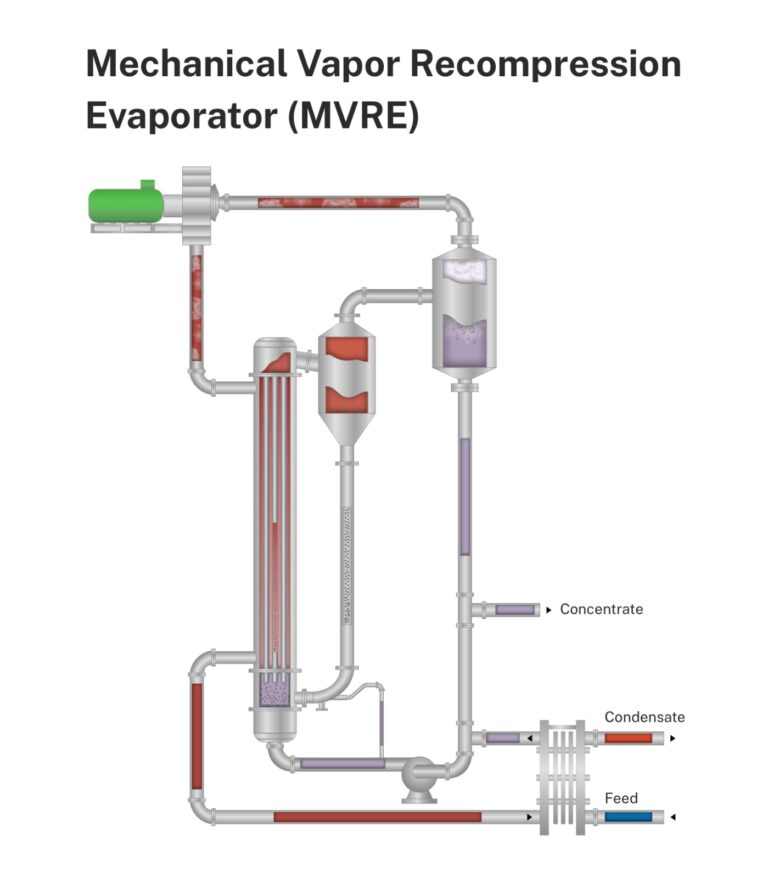
The 150-Year Lag in Industrial Efficiency The Historical Gap
In the world of industrial thermodynamics, the solution to massive energy consumption in evaporation and distillation was conceptually born in the 19th century. By 1830, Multiple Effect Evaporation (MEE) began replacing inefficient open-pan evaporation. However, it took another 150 years—until roughly 1980—for Mechanical Vapor Recompression (MVR) to be fully adopted as the industrial standard for concentrating product streams.
The Philosophy of Wastage
Engineering is ultimately the art of reducing wastage. This is achieved by moving beyond basic operations and rigorously observing the system through two lenses:
Critical Mass Balance: Tracking every kilogram of product and solvent through the cycle.
Energy Balance: Understanding exactly where calories are lost.
The Evolution of Vapor Recompression
Historically, the concept of recompressing steam was used in niche applications, such as extracting maximum work from turbine exhaust or even reducing acoustic noise in steam locomotives by recompressing the drive system’s exhaust.
Today, MVR stands as the pinnacle of this logic. Unlike Thermal Vapor Recompression (TVR), which relies on high-pressure motive steam, MVR uses mechanical energy to “upcycle” low-grade waste vapor into high-grade heating steam.
Why MVR Wins on Efficiency
While the industry has yet to adopt MVR at a “full-fledged” global scale, its benefits are undeniable:
Thermal Energy Savings: It drastically reduces the need for “fresh” boiler steam.
Condensate Quality: It produces significantly less steam condensate than TVR systems, simplifying water management.
Sensible Heat Recovery: It enables the reuse of the steam’s sensible heat, effectively “closing the loop” on the thermal cycle.
👉 Conclusion:
MVR isn’t just an upgrade—it’s the culmination of 150 years of industrial thermodynamics, redefining efficiency for modern industry.