
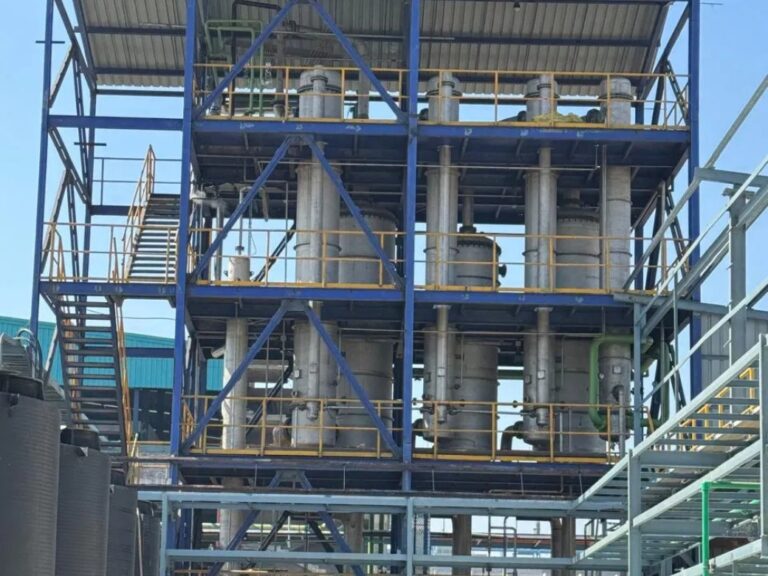
From Calculation to Commissioning: Bridging the Gap in Evaporator Design
Design engineering often exists in a realm of theoretical mass balances and idealized heat transfer coefficients (U). However, the commissioning phase frequently introduces harsh realities: air ingress, Net Positive Suction Head (NPSH) deficiencies, and unexpected thermal stagnation.
Drawing from extensive field experience with Multiple Effect Evaporators (MEE), the following three pillars represent the critical transitions required to move a design from a theoretical model to a high-performing industrial asset.
1. The Impact of Non-Condensable Gases (NCG) on Heat Transfer
While thermal calculations may assume a clean U-value, the presence of non-condensable gases acts as a significant insulator. A failure to implement a robust venting strategy will lead to a precipitous drop in the heat transfer coefficient.
The Technical Reality: Air and other non-condensables accumulate in the shell side of the calandria, creating a stagnant film that prevents steam from reaching the tube surface.
Commissioning Indicator: If the first effect fails to reach boiling point despite adequate steam pressure, the primary suspects should be condensate backup (a “drowned” calandria) or air-locking. Effective venting at both the top and bottom of the steam chest is essential to maintaining the driving force.
2. Strategic Selection: Falling Film vs. Forced Circulation
Selecting the correct flow regime is vital for operational longevity. While Falling Film Evaporators offer superior energy efficiency and a low temperature difference (Delta T), they are highly sensitive to solids and scaling.
Design Optimization: In processes where concentration leads to crystallization, a hybrid approach is often the most resilient.
The “Final Effect” Strategy: Utilizing Forced Circulation for the final effect—where solids concentration is highest—is a standard best practice. The high-velocity “scouring” action within the tubes prevents precipitation and fouling. This strategic trade-off in energy for mechanical reliability prevents the frequent downtime associated with high-pressure water jetting.
[Image comparing falling film evaporator flow vs forced circulation evaporator flow]
3. Thermodynamic Constraints and Hydraulic Integrity
A common pitfall in evaporator design is the underestimation of Boiling Point Elevation (BPE). As the solute concentration increases, the boiling point rises, effectively shrinking the available temperature driving force (Delta T).
The Vacuum Paradox: Achieving a deep vacuum is only half the battle. During commissioning, pump cavitation is often observed even when vacuum levels are within specification.
NPSH and the Barometric Leg: In vacuum systems, pumps must overcome significant physical resistance to extract boiling liquid. If the vessel’s elevation—the Barometric Leg—is insufficient, the NPSH Available will drop below the NPSH Required. Failure to respect these hydraulic head requirements leads to immediate mechanical failure and loss of throughput.
Conclusion:
A successful commissioning is not the result of better calculations, but of a design that anticipates the physical variables of the plant floor. Respecting gas venting, material rheology, and hydraulic head is the difference between a theoretical success and an operational one.