
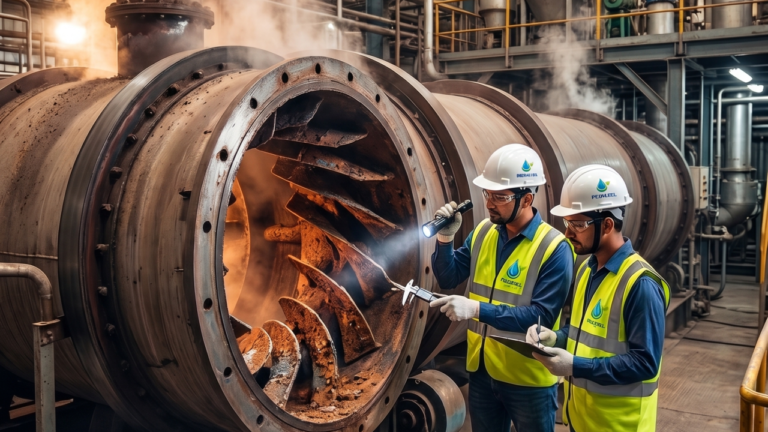
In process manufacturing, the industrial dryeris the final gatekeeper of product quality. Whether you are processing pharmaceutical powders, food ingredients, or mineral concentrates, your dryer dictates yield, energy efficiency, and safety.
Yet, too often, this critical asset is treated as a simple black box: heat goes in, moisture comes out. When operations go wrong, the financial impact is immediate.
I frequently see process lines running at reduced capacity or facing frequent downtime simply because a fundamental operational parameter—be it thermodynamics or mechanics—has drifted out of balance.
Here are three common industrial drying failures I encounter on-site, the underlying science behind why they happen, and how a targeted process engineering fix can recover your production.
1. The Spray Dryer ‘Sticky Zone’ and Wall Caking
The Problem: During a production run, yield at the cyclone drops dramatically. Operators inspect the dryer and find a thick, sticky buildup of semi-dried material caking the entire internal drying chamber.
The Process Science: You are likely processing an amorphous material (like high-sugar fruit juice or a specific polymer). This material has a specific thermodynamic threshold called the Glass Transition Temperature (Tg). When the wet particle temperature exceeds its Tg, it transitions from a brittle glass to a sticky, rubbery state. It instantly adheres to any surface it touches.
The Fix: You must lower the particle temperature before it makes wall contact.
- Operational adjustment: Lower the drying air inlet temperature, though this sacrifices capacity.
- The Engineering Solution (Non-Sacrificial): Install an Air Broom or introduce a cooling medium into a Cooling Jacket around the chamber. This creates a cool boundary layer at the wall, keeping the product below its sticky point without lowering the overall process temperature.
2. Rotary Dryer ‘Slip’ and Thermal Inefficiency
The Problem: The burner is consuming excessive fuel, but the mineral concentrate or chemical product leaving the rotary drum is still high in moisture. Efficiency has plummeted.
The Process Science: This is rarely a burner issue. In a rotary dryer, the internal lifters, or Flights, are the lifeblood of the operation. They must lift and cascade the material, creating a magnificent “curtain” (veil) that maximizes heat transfer surface area. If these flights are worn down or corroded, they fail. The material bed simply slides or ‘slips’ along the bottom. The hot gas passes over it without performing useful drying.
The Fix: The only solution is mechanical intervention. You must inspect and replace the internal flights to restore proper material distribution and maximize air-to-solid contact. A simple mechanical fix often restores original design capacity.
3. Case Hardening in Continuous Conveyor Dryers
The Problem: Sliced sweet potatoes or snacks emerge from the conveyor belt hard and crisp on the outside, but when snapped open, the center is still wet, dense, and raw.
The Process Science: The initial drying stage is too aggressive. The rate of surface evaporation vastly exceeds the rate of internal moisture diffusion. This forms an impermeable skin, or ‘case,’ that seals the moisture inside.
The Fix: Implement Zone Drying or Staged Drying. Counterintuitively, you must increase the relative humidity (RH) and potentially the temperature in the very first zone. This high-humidity zone keeps the surface moist, preventing a ‘case’ from forming while heating the core to accelerate moisture diffusion. The product can then enter a final low-RH zone to fully flash off the remaining moisture.
Moving Your Process From Problem to Profit
These failures aren’t inevitable. They are clear signals that your system’s thermodynamic or mechanical inputs require professional synchronization. Understanding the “why” allows you to apply the precise “how.”
At PROJEXEL Process Equipments, we specialize in the design, optimization, and installation of complex evaporative, drying, and separation solutions, including Multiple Effect Evaporators, Zero Liquid Discharge Plants, and specialized Dryers and Mixers.
If your process is battling inconsistent quality, low yield, or high energy costs, let’s start a conversation.
Connect and Consult:
Contact PROJEXEL Process Equipments Pvt. Ltd.